
Peaked quantum circuits with Hrant Gharibyan
In this episode of The New Quantum Era, Sebastian talks with Hrant Gharibyan, CEO and co‑founder of BlueQubit, about “peaked circuits” and the challenge of verifying quantum advantage. They unpack Scott Aaronson and Yuxuan Zhang’s original peaked‑circuit proposal, BlueQubit’s scalable implementation on real hardware, and a new public challenge that invites the community to attack their construction using the best classical algorithms available. Along the way, they explore how this line of work connects to cryptography, hardness assumptions, and the near‑term role of quantum devices as powerful scientific instruments.
Topics Covered
Topics Covered
- Why verifying quantum advantage is hard The core problem: if a quantum device claims to solve a task that is classi-cally intractable, how can anyone check that it did the right thing? Random circuit sampling (as in Google’s 2019 “supremacy” experiment and follow‑on work from Google and Quantinuum) is believed to be classically hard to simulate, but the verification metrics (like cross‑entropy benchmarking) are themselves classically intractable at scale.
- What are peaked circuits? Aaronson and Zhang’s idea: construct circuits that look like random circuits in every respect, but whose output distribution secretly has one special bit string with an anomalously high probability (the “peak”). The designer knows the secret bit string, so a quantum device can be verified by checking that measurement statistics visibly reveal the peak in a modest number of shots, while finding that same peak classically should be as hard as simulating a random circuit.
- BlueQubit’s scalable construction and hardware demo BlueQubit extended the original 24‑qubit, simulator‑based peaked‑circuit construction to much larger sizes using new classical protocols. Hrant explains their protocol for building peaked circuits on Quantinuum’s H2 processor with around 56 qubits, thousands of gates, and effectively all‑to‑all connectivity, while still hiding a single secret bit string that appears as a clear peak when run on the device.
- Obfuscation tricks and “quantum steganography” The team uses multiple obfuscation layers (including “swap” and “sweeping” tricks) to transform simple peaked circuits into ones that are statistically indistinguishable from generic random circuits, yet still preserve the hidden peak.
- The BlueQubit Quantum Advantage Challenge To stress‑test their hardness assumptions, BlueQubit has published concrete circuits and launched a public bounty (currently a quarter of a bitcoin) for anyone who can recover the secret bit string classically. The aim is to catalyze work on better classical simulation and de‑quantization techniques; either someone closes the gap (forcing the protocol to evolve) or the standing bounty helps establish public trust that the task really is classically infeasible.
- Potential cryptographic angles Although the main focus is verification of quantum advantage, Hrant outlines how the construction has a cryptographic flavor: a secret bit string effectively acts as a key, and only a sufficiently powerful quantum device can efficiently “decrypt” it by revealing the peak. Variants of the protocol could, in principle, yield schemes that are classically secure but only decryptable by quantum hardware, and even quantum‑plus‑key secure, though this remains speculative and secondary to the verification use case.
- From verification protocol to startup roadmap Hrant positions BlueQubit as an algorithm and capability company: deeply hardware‑aware, but focused on building and analyzing advantage‑style algorithms tailored to specific devices. The peaked‑circuit work is one pillar in a broader effort that includes near‑term scientific applications in condensed‑matter physics and materials (e.g., Fermi–Hubbard models and out‑of‑time‑ordered correlators) where quantum devices can already probe regimes beyond leading classical methods.
- Scientific advantage today, commercial advantage tomorrow Sebastian and Hrant emphasize that the first durable quantum advantages are likely to appear in scientific computing—acting as exotic lab instruments for physicists, chemists, and materials scientists—well before mass‑market “killer apps” arrive. Once robust, verifiable scientific advantage is established, scaling to larger models and more complex systems becomes a question of engineering, with clear lines of sight to industrial impact in sectors like pharmaceuticals, advanced materials, and manufacturing.
The challenge: https://app.bluequbit.io/hackathons/
Creators and Guests


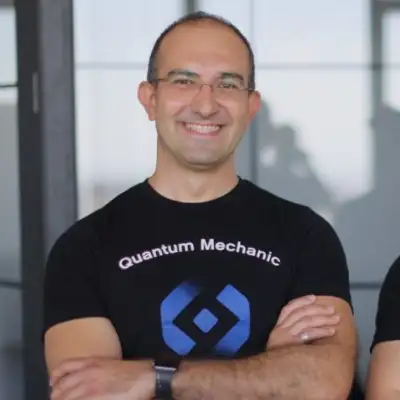
Guest
Hrant Gharibyan
Hrant is co-founder and CEO of Blue Qubit. He earned his PhD in physics at Stanford, focusing on quantum information and black holes, and was a postdoc at Caltech before founding Blue Qubit.